Malingerer
Like many people, I don’t usually really think much about Remembrance Sunday and Armistice Day. I observed the ritual and the silence but without actually thinking about war, commitment and sacrifice. Today’s two minute silence was different.
Recently I uncovered a document of my maternal grandfather’s service in the British Army during the Second World War, particularly that covering an inquiry into his health and subsequent medical discharge. The document gives a profound insight into the officer class, and their opinion on the men for whom they had responsibility.
Shortly after the outbreak of war, my granddad was conscripted as a sapper, a class of soldier whose jobs could range from digging ditches or breaking enemy things for tactical reasons. He was in his early thirties. He spent some time breaking things before he received a chest wound in action. After treatment for his wounds, rather than being discharged he was sent to work as a manual labourer at a depot at Scapa Flow. Here the conditions for ordinary servicemen were tough. My granddad, who had grown up barefoot on the banks of the Tyne in the worst area of Tyne Dock was used to tough, but while living in an unheated tin shed at Scapa Flow he contracted tuberculosis. He faced more treatment, losing some lung function in the process.
After a break to visit his family in South Shields, he was again returned to Scapa Flow. Despite the time away, he found that living conditions had not improved, and whilst working on moving provisions discovered that officers enjoyed a very different and better life. Feeling his health again deteriorate in the cold and wet living conditions, my granddad then committed a terrible crime.
He complained.
A board of officers reviewed his complaint and an inquiry was held. Statements from officers and doctors were collected and entered onto the document. One doctor defined my grandad in his statement as a ‘borderline malingerer’. One of his officers, who my granddad barely knew, classified him as a ‘barrack room lawyer’.
The board found that as no other men had complained there was no case to answer, but rather than censure my granddad recommended that he be discharged on medical grounds. After several weeks of light duty with a different squad he was sent home to his family for good.
My grandad never spoke about this. He never considered himself or his war service as anything special. When he was asked if he wanted to become a Chelsea Pensioner he turned it down. The uniform life was not for him. What he was left with was the feeling that justice demanded that ordinary people deserve better lives, in a society where everyone helps each other, not reliant on doffing a cap to a patronising elite for charity. He was no socialist, but like many others he voted for his aspirations for a better Britain, and helped usher in one of the greatest governments this country has ever seen. A post-war government that went to war on poverty, sickness and ignorance.
On Sunday I saw David Cameron at the Cenotaph do his solemn look for the cameras. Cameron and his peers are from the same strata of society as those officers who looked down on my grandad and considered this rough-talking tough northern man as little more than an awkward oik. I thought about that solemn look in the two minute silence today. On the face of a man who is doing everything he can to undo what my grandad and his generation helped build.
No mock solemnity, no matter how well acted, can hide that David Cameron and the Tories are betraying the memories of those, like my granda, who came back from war, and with their families, rebuilt Britain.
Labour values: ‘We can’t help everyone’
Emma Lewell-Buck just can’t help it. In today’s Shields Gazette she decried the emptiness of David Cameron’s tough words on the Calais migrants issue, without any suggestion of what she or Labour would do to resolve the problem.
Presumably no one has told her yet.
What irked me most was that the article showed a complete lack of empathy; not just in her own words, but in the visitor comments below the article. The people in Calais are hoping for a better life; a job, opportunity, a chance for freedom, or a haven from persecution, violence or death.
So I commented:
It says everything about the pathetic state of Labour that the South Shields MP jumps on the anti immigrant bandwagon to keep the Labour leadership happy and at the same time attempt to appeal to BNP and UKIP voters. It is reassuring though that people like Emma Lewell-Buck and most of the commenters below are in the minority (particularly the charming den ‘final solution’ patton) and that most British people are actually decent, empathetic human beings.
To put it in perspective, we have a population of over 60 million, but there are around 3,000 migrants in Calais. We are also one of the wealthiest countries in the world so not only can we afford to support these people in difficulty, we should. Sadly Emma Lewell-Buck is part of a political-economic system which prefers to maintain the status quo which makes the poor poorer and the rich richer, and rather use these people in trouble as an opportunity for cheap political point scoring rather than actually improving lives.
Maybe we can’t help everyone. But we should try, and for an MP, it should embody the reason they went for the job in the first place: to help people.
Anything else is a betrayal to Labour voters, and what were once Labour principles.
Where are South Tyneside’s Labour MPs?
This image is a snapshot of an alphabetical list from Hansard, of MPs who voted against the Tory Welfare Bill last night.
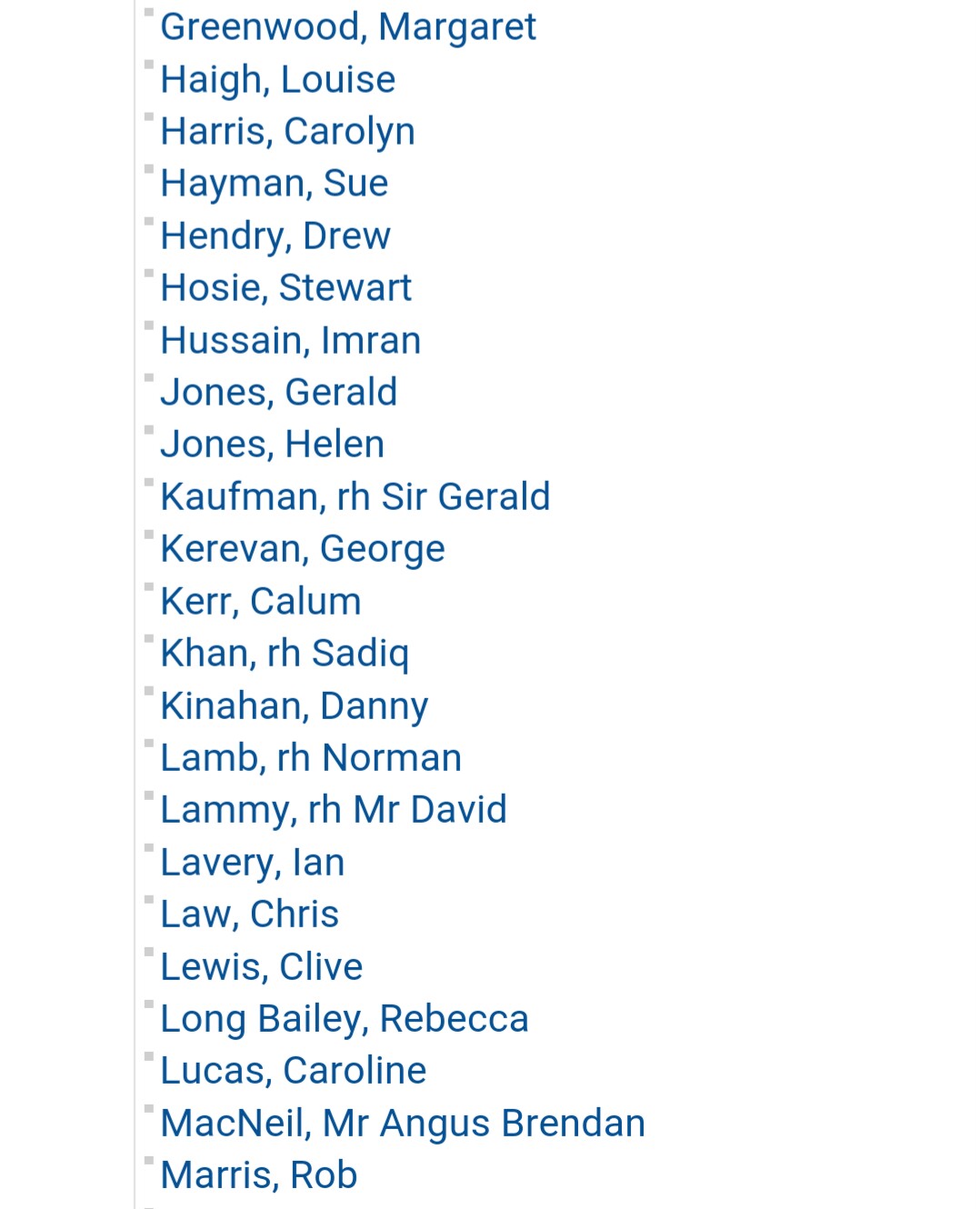
You’ll note that South Tyneside’s two Labour MPs, Stephen Hepburn and Emma Lewell-Buck are missing. That’s right, along with most other Labour Party MPs they failed to vote against a bill that the Tories will use to further hobble the welfare state and make the lives of people on low incomes in South Tyneside worse.
You would think MPs were there to vote in the interests of their constituents, but not these two. They voted for party before principle.
After the vote SNP MP Peter Wishart asked the speaker of the house if Labour could be moved to the back benches as they no longer represent an opposition to the Tories. He’s got a point; in the last year or so Labour has consistently voted in support of Tory economic policy.
If I was a Labour Party member in South Tyneside, today I would be asking myself some very serious questions. Is Labour fit for purpose? Does it still represent my values? Why did I waste my time canvassing for two losers who can’t vote to protect fundamental Labour principles?
Tree silhouette that looks like a cat
Not quite pareidolia, but an insight into the brain’s (or Brian’s) faulty model recognition engine.

The gift of sin, in a box
Fast food companies learned a long time ago that if you want to hook customers when they’re young, give them toys. Kids love them, and they’ll want to go back for more. Not long and they’ll be going not for the toy but for the food. It’s how they build their brand awareness.
Cynical? Yes.
So it’s no surprise that religious organisations use the same technique. Organisations like the evangelical church Samaritan’s Purse, which runs the Operation Christmas Child shoebox appeal every year. They give some poor kids in an awful place some toys, and expose them to their brand. Religion.
Cynical? Yes.
But where the fast food companies only want to sell food, Samaritan’s Purse want to sell everlasting torment, unless the child accepts that Jesus died for their sins 1 thousands of years before they were even born.
Creepy.
Here in South Tyneside though, instead of protecting children from some deeply disturbing ideology, people like Jarrow MP Stephen Hepburn and mayor Fay Cunningham positively celebrate proselytising to children using toys. Toys in boxes often gifted by other children. Maybe they’ve fallen for the attractive concept of putting a smile on the faces of unhappy children. But it’s the idea that goes with the smile that should be worrying.
Sin. A made up condition for which they sell the made up cure.
So here are South Tyneside’s politicians, smiling for the camera, celebrating gifting shoeboxes with toys, guilt and sin.
Watch the video. It’s sickening.
Live Long And Prosper
Leonard Nimoy died today. But that’s not the end. Every atom in his body will move on to become another part of the universe. At some point before the universe dies, maybe one of the atoms resting in you or me will momentarily meet with one of the atoms that briefly visited him. Maybe it’s already happened.
His legacy will live on – for the joy he gave as an entertainer and for the overwhelmingly positive thoughts and ideas he left behind. And as last words go, Leonard Nimoy’s final tweet demonstrates the touching humanity of a man acutely aware of his mortality, a man who is famous for pretending not to be human.

Don’t vote red and get blue – go Green!
In the dying light of 2014, Jarrow Labour MP Stephen Hepburn wrote a rousing piece for the Shields Gazette, where he slammed ‘Tory austerity’ and told the Gazette’s readers that “Labour would be very different. We’re on your side.”
Well, actions speak louder than words, and to show whose side he and Labour are on, today he voted with the Tories in support of their ‘budget charter’ bill, rubber stamping another £30 billion of cuts. Predicably, South Shields Labour MP Emma Lewell-Buck also voted with the Tories, but when it comes to voting against the interests of the people of South Shields who are suffering under Tory-Lib Dem coalition austerity, she already has form for putting the whip before people. Now it’s election year, Hepburn is toeing the Blairite line too.
Hepburn is right about one thing. There is a ‘momentous choice facing us’, and it’s a choice between voting for a fairer society where everyone benefits, or the status quo. As we’ve seen today, the Tories, Lib Dems and Labour will do anything to keep the fat cats purring, even if it means making life harder for the people who are already struggling.
For me that momentous choice is simple. The Green Party is the only party that still holds to the principles of Bevan and Beveridge, now abandoned by a Labour Party that looks to Thatcher and Blair for its inspiration. The Green Party wants to bring our society back together, where every citizen shares in Britain’s success. To stop Britain being a cow to be milked by the haves, paid for by the have nots, we do need to make that momentous choice. Something different, something better, for everyone – the Green Party.
Red Rain

Peter Gabriel and Red Rain.
Red Rain by Brian Paget on Flickr.
Just follow this link to see and comment on this photo:
https://flic.kr/p/q1Vw8V
Our MP wants to save the NHS
Over at the Shields Gazette, South Shields MP Emma Lewell-Buck slaps herself on the back for courageously voting for whatever lobby fodder are told to vote for. And what could be more core Labour voter friendly than a soft soap early day motion that makes all the right NHS noises?
The Tories and Lib Dems may be holding the axe to the neck of the NHS, but Labour brought it to its knees. Before the Tory reorganisation, Labour saddled the NHS with its very own reorganisation, the Private Finance Initiative. PFI has landed NHS trusts with decades long debts worth billions. On top of that, Labour obligated trusts to offer services to private providers, even if the NHS services were better value for money. Even without the Con-Dem slashing, a Labour government would have meant cuts to NHS services.
Labour put profits before people.
If Labour is serious about saving the NHS, then cancellation of PFI debt must be at the top of the wish list. Next would be to put the NHS at the heart of a British constitution to stop future governments using the NHS as a political and profit football.
But it won’t happen. Labour is as wedded to dismantling public services and handing them to the circling privatisation vultures as the Tories, Lib Dems and Ukip.
Together
So the family of nations of the UK will remain together. For now. We have been handed an opportunity to build a new, better UK – for all of us. Cameron’s offer of pseudo devo city regions should be ignored as a cynical attempt to silence calls for regional and national devolution under a federal government, with a model which will pit city against city, each competing for scraps from Westminster’s table.
Scotland has lead the way and the debate has shown there is a desire for a better, fairer and more representative democracy. This isn’t the end of Scottish independence, it should be seen as an opportunity for all the parts of the UK to campaign together for more local democratic self determination.
Despite the inevitable posturing over the result, Westminster is running scared. They know we have the power to make changes for the better. After yesterday, we know it too.
And that’s why we need to keep them worried.
 Brian Paget